Wednesday, November 23, 2011

Rock Beats & Rhythms: Drum Lessons : Playing the Standard Eighth Note Beat

Play the standard eighth note beat with the kick drum, snare drum and hi hat cymbals when playing rock rhythms and beats on the drums; learn how with tips from our professional rock-and-roll drummer in this free drum tutorial video. Expert: Shaun Schaefer Bio: Shaun Schaefer is the drummer for Platinum recording artist Blessid Union Of Souls. An award winner, Schaefer has toured the world and played for the masses including our troops in Afghanistan. Filmmaker: matt senatore

Shop For Crocodile Shoes

Wednesday, November 16, 2011

Drum Lessons

Bored to death of practicing? Try this... ‪DrumLessons.com . This beginner drum lesson will teach you to play drums for the very first time. It shows the basic drumming essentials. You can find more drum lessons on our website. . www.FreeDrumLessons.com http

!8!# Wholesale Baldwin Digital Piano Last Minute Panasonic Yd250 Promotions Marpac Sleepmate

Saturday, November 5, 2011

Rock Band 2 Drum Set! (Premium Drum)

-Price: 0.00 -MORE INFO ABOUT RB 2 VISIT DRUMROCKER.COM Don't just play games. Play DRUMS! Drum Rocker delivers the most realistic drumming experience available to any gamer, regardless of platform. That's because it was built by the engineers at Alesis, one of the largest manufacturers of professional electronic drums in the world. As a result, you get a kit that's designed to take a real beating, with all the positioning flexibility that professional drummers demand. While other drum controllers lock you down to a pre-molded plastic array of pads, Drum Rocker's professional aluminum drum rack lets you position your snare, tom and cymbal pads wherever you want. When you're ready to move from playing Rock Band to playing in a rock band, you can swap the game controller module with one of the professional drum brains made by Alesis, and you're ready to hit the road for real! Ultra-quiet velocity sensitive pads. Drum Rocker's velocity-sensitive drum pads feature a playing surface that is much quieter than other drum controllers. They also feel great -- the stick rebound off of the pad is much more natural and consistent than anything else available. The pad housing is made of high-impact plastic, designed to be whacked on stage night after night. No matter how much you punish them, the Drum Rocker drum pads can take it. The pads are mounted to the drum rack with a metal L-Arm and clamp system, which allows them to be tilted, swiveled, raised and lowered to whatever ...

Horizon Elliptical Trainers Buy Now

Friday, October 14, 2011

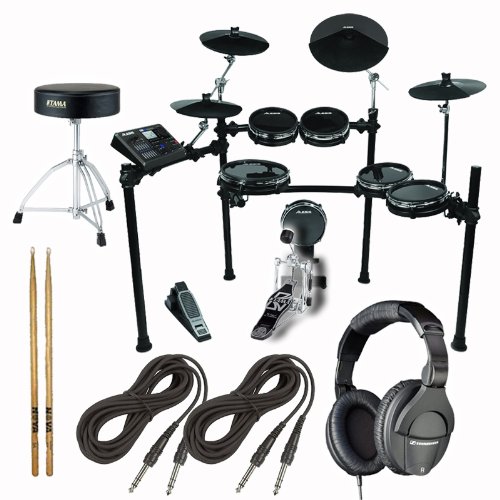
Alesis DM10 Studio Electronic Drum set DM 10 Studio

!±8±Alesis DM10 Studio Electronic Drum set DM 10 Studio

Brand : Alesis
Rate :
Price :
Post Date : Oct 14, 2011 14:28:22
Usually ships in 1-2 business days


This Special Package Includes All Accessories Packaged In The Alesis DM 10 Studio Kit Plus* 1 Pair of KRK KNS 6400 Headphones - for monitoring and private playing, 1 Tama HT30 Drum Throne, 1 Tama HP30 Single Kick Pedal, 2 Ten Foot Balanced TRS Cables, 1 Pair of Vic Firth Nova 5A Nylon Tip Drum Sticks. This package was specially designed by the experts at Sonic Sense Pro Audio to have you ready to play as soon as your shipment arrives.

!8!# Shop Proform 950 Elliptical Trainer !8!# Purchasing Petsafe Dog Door

Saturday, October 8, 2011

How to Practice Guitar Effectively

!±8± How to Practice Guitar Effectively

An Effective Guitar Practice Schedule Feel free to practice these things in any order, but always do #1 first, the warm up. You also don't have to do them all in one sitting either. You can do a few at one practice session, and next time you sit down to practice, you do the other items in the list you didn't do the first time, etc. Also, feel free to change the number of minutes for each to suit your own needs. Maybe you want to practice for 2 hours; maybe just 30 minutes - it is completely up to you. You can view this schedule as a general blueprint, which you can modify as you like.

Warm-up - 5 minutes. First of all - tune your guitar! Then, play anything you like, but don't do anything that is really hard on the muscles in your hands. Let them get warmed up first. Scales - 10 minutes. Work on scales you don't yet know well. You probably have scales tabbed out and printed. Take your time and play these slowly with the metronome. Play the notes of the scale in question in any order, random, sequential, etc. As you do this, try to visualize in your head the patterns this scale creates on the fretboard. Over time, you will be able to "see" the scale on the fretboard without thinking much about it. Arpeggios - 10 minutes. Do the same as with the scales mentioned above. An arpeggio is a group of notes which are played one after the other, either going up or going down, where the notes belong to one chord. Again, visualize and try to remember the patterns you play. Chords - 10 minutes. Learn new voicings of chords. Learn new chords. Practice chord progressions with some of the new chords you are learning. Theory - 5 minutes. Get a good book about music theory. There are many out there. Alfred Essentials of Music Theory: Complete Self-Study Course (Book/2-CD) Technique - 10 minutes. Work on things that need improvement or that may be new to you, for example - hammer-ons, pull-offs, bends, strumming, alternate picking, sweep technique, tapping, etc. Fretboard training - 10 minutes. Set the metronome at a low BPM. Start with any note you want. Find and play that note for every click of the metronome on every string, but start with 2 strings at a time. Once you have that down, move to 2 more strings, then practice finding that note on those 4 strings. Continue with the last 2 strings and finally do all 6 strings. Play the notes in any order and direction. The purpose here is to find the note in question as quickly as you can. It will become "transparent" with enough training - you will be able to find any note anywhere on the fretboard without having to think Work on a song - 10 minutes. Work on a song which has something challenging in it, something that gives you an opportunity to practice something new. Reading music - 10 minutes. Work on reading TAB and music notation. Practice reading rhythms, notes and sight reading. Transcribe something - ANY minutes. This is the best way to teach yourself, and it's fantastic ear training. Listen to a few seconds of a song, over and over. Imitate best you can, try to figure out one note at a time. This means replaying the same sequence many times. After a while, you will be able to do this quicker, as well as picking out more than one note at a time. Play anything - ANY minutes. Noodle around and play whatever you want - playing should first and foremost be FUN!

Important things to remember

Always tap your foot with the metronome and the rhythm you are playing. That way, you will lock your body into the meter, and you will become good at playing tight. Good timing is soooo important! I cannot stress this enough. Use that metronome/drum machine! Any time you are working on something with a beat to it, get that metronome/drum machine going. You get two benefits at one time - you may be working on scales, chords, etc, but at the same time, you will also improve your timing when you practice this to the metronome. Visualize the notes you are about to play. Practicing enough will get you to the point where, for example, you can see the note "A" on the B string before you actually play it. Record yourself regularly, and then listen back to it with critical ears. What problems do you notice? Timing issues? Are notes played cleanly and accurately? Determine what the weaknesses are, and focus on correcting them. Sing the notes - as you are playing through, for example, a scale or an arpeggio, sing the notes as you are playing them. This will train your ear and will also help you learn where the notes are on the fretboard. Play with others - jam with friends, your teacher, anyone, or play along with backing tracks. Play something for your friends and family. Get a little gig somewhere - it will help you stay motivated. Playing with people with improve your ear and you will develop your musicianship further and quicker.

Hope you find these tips useful. Remember, a focused practice routine will lead to improvements faster.

Lastly, don't forget the most important part - TO HAVE FUN!


How to Practice Guitar Effectively

!8!# Oriental Lamps Ideas


Sponsor Links